
Distributed media nodes
Media capacity can be hosted by different participating organisations and used as part of a shared pool.
How it works
A federation model that combines local service identity with shared orchestration and distributed media resources.
Federation model
eduMEET Federation separates infrastructure hosting from service orchestration. Infrastructure contributors provide server resources for media nodes, while the eduMEET team manages the software layer, installation, updates and federation-level operation.
Organisations that cannot host media nodes can subscribe and use the federated infrastructure without operating their own: companies, public administration and NGOs directly, research and education institutions through their NREN. When users join a meeting, media traffic is assigned to an appropriate node based on geography and current load.
If a node becomes unavailable or reaches capacity, the federation can route participants through other available nodes to preserve service continuity.
A compact view of how an organisation connects to the shared eduMEET Federation infrastructure.
Reference architecture
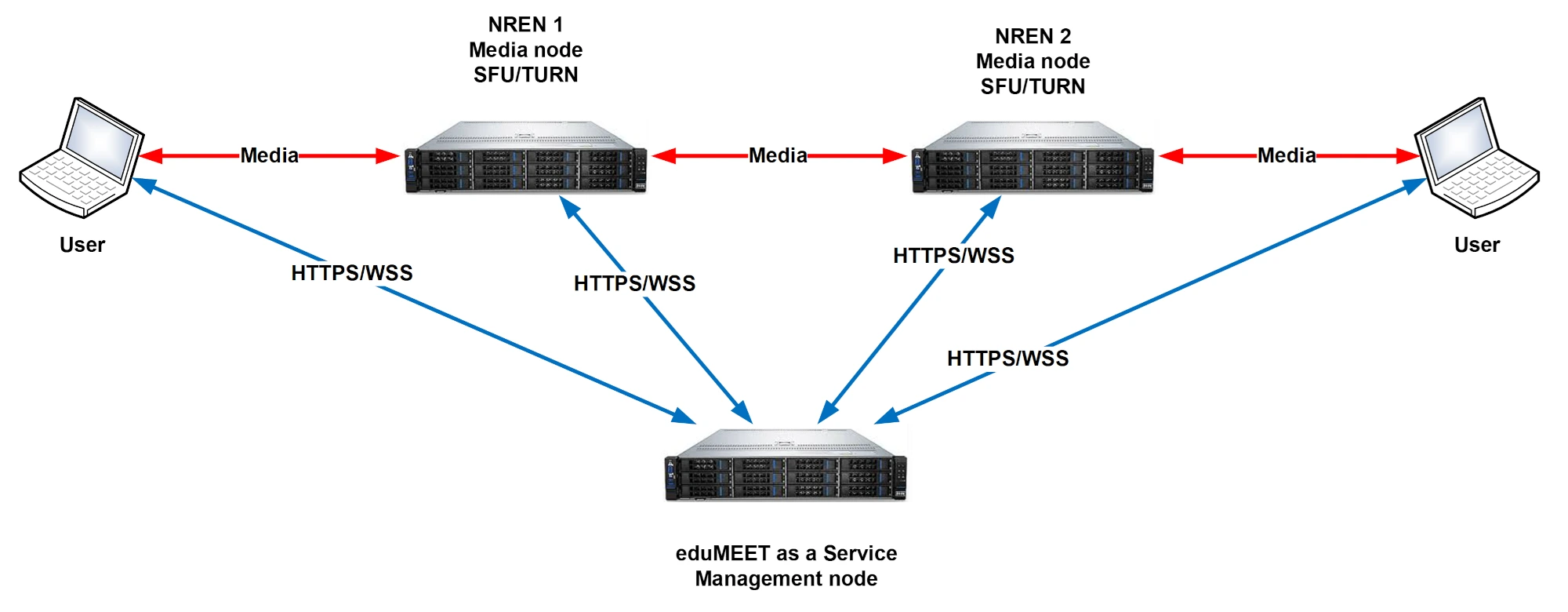
The reference diagram shows users connected to distributed SFU/TURN media nodes, with the eduMEET as a Service management node coordinating the service through HTTPS/WSS connections.
Core capabilities
Media capacity can be hosted by different participating organisations and used as part of a shared pool.
The service model coordinates routing, software management and federation-level operation.
Traffic can use appropriate nodes based on location and current load.
If a node becomes unavailable or saturated, traffic can be routed through other available nodes.
Participants can run a dedicated tenant under their own domain.
Institutional sign-in via OpenID Connect or SAML, including eduGAIN-based identity providers.
Audience
eduMEET originated in the European Research and Education community, but the federation model is relevant to a broader group of organisations that need secure, scalable and privacy-respecting video collaboration.
Next step
Provide media-node capacity and run your own trusted video service.