
Joining the federation
For matters related to joining eduMEET Federation as an infrastructure contributor or service subscriber.
join@edumeet.eu
Contact the joining teamTechnical onboarding
Technical requirements and configuration steps for organisations joining the eduMEET Federation.
Overview
This page describes the requirements for infrastructure providers who wish to join the eduMEET Federation and use eduMEET common services.
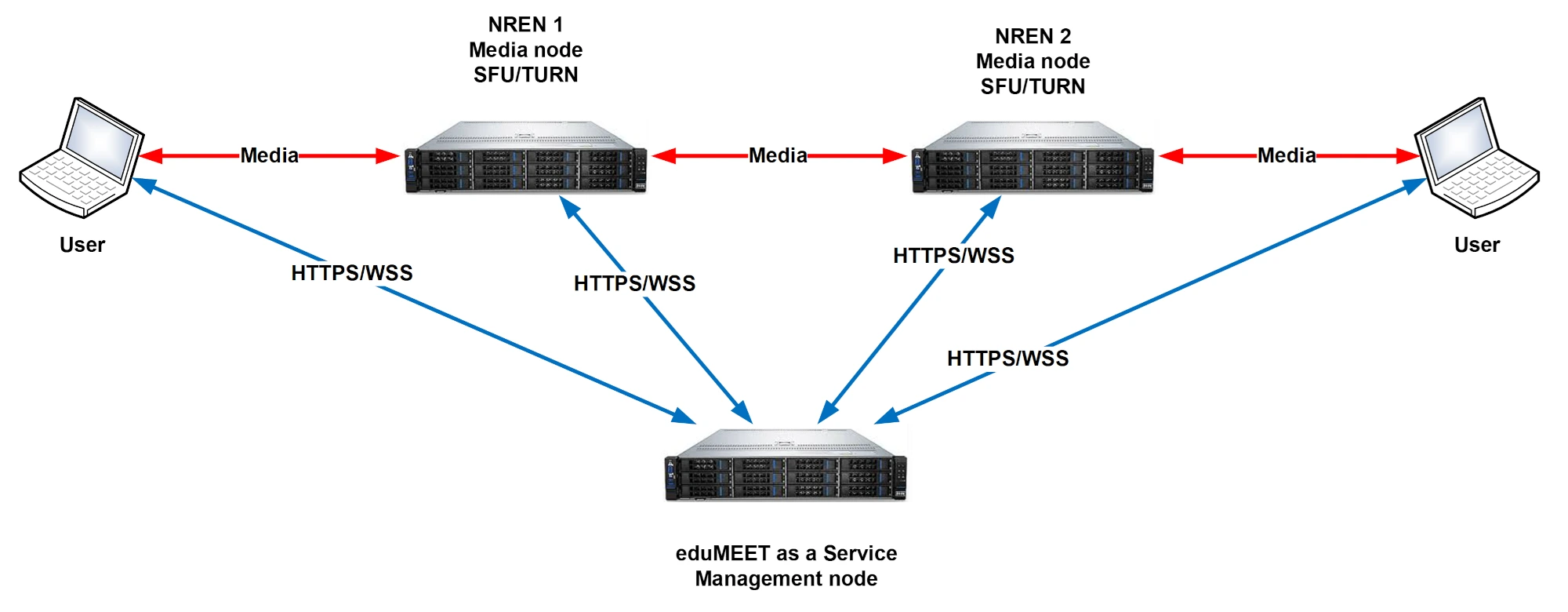
The federation shares infrastructure resources for flexibility and scalability in the delivery of web conferencing services. It is centrally managed, while audio-video connections are optimised between distributed media nodes.
Assignment to a node is based on geographical location and node load. If a node reaches its maximum load, subsequent participants in the call use a different node, and the system provides routing between nodes.
Architecture
This diagram illustrates the same model described in the onboarding requirements: distributed media nodes for audio-video traffic, and a centrally operated management node for service coordination.
Infrastructure providers
The infrastructure provider receives access to a web conferencing service for its own use. The service is launched in
the provider’s domain, for example edumeet.nren-1.org, and can be integrated with an
OpenID Connect-based identity provider, for example eduGAIN.
The provider gains access to an administrative service for their domain, where they can manage users, permissions and rooms.
During the pilot period, the service is free of charge for the provider. After the pilot period, based on the volume of infrastructure provided, the pool of simultaneously connected users that can use the service without generating costs for the provider will be calculated. In the event of long-term excess usage beyond that volume, an extension with additional infrastructure or the setting of an excess fee will be negotiated with the provider.
Service subscribers
Organisations that join as service subscribers do not need to provide local media node infrastructure. Companies, public administration and NGOs subscribe to an organisation plan; research and education institutions use the service through their NREN. See subscription.
The server, firewall and DNS requirements below primarily apply to infrastructure contributors. Subscriber onboarding (subdomain, logo and colours, institutional sign-in) is carried out by the eduMEET Federation team following a standard checklist.
Requirements
Detailed requirements for the server, firewall, DNS and optional SSO configuration are presented below.
Servers made available for web conferencing as media nodes should follow this sizing rule:
| CPU | RAM | Storage | Network |
|---|---|---|---|
| Up to 16 cores | 8 GB | 80 GB SSD/HDD | 1 Gbps |
| Up to 48 cores | 16 GB | 80 GB SSD/HDD | 2.5 Gbps |
| Up to 128 cores | 32 GB | 80 GB SSD/HDD | 10 Gbps |
The server is physically operated by the provider. It can be a physical or virtualised server. The server must have a public IPv4 address accessible from the Internet.
The provider installs Ubuntu 24.04 on the server and adds the installation public key to the trusted SSH keys of the root user:
ssh-ed25519 AAAAC3NzaC1lZDI1NTE5AAAAIK4OD1LfqRHzQe0rMsF7E6VlcF4nQV4HhBNeW4WT0Q0LAt the operating system and eduMEET software level, maintenance and management are the responsibility of the eduMEET team.
The provider configures the server access firewall according to the following rules for incoming traffic:
| Source | Protocol / port | Purpose |
|---|---|---|
| ALL | ICMP | Ping |
| 167.235.130.84 | TCP 22 | SSH - installation and maintenance access |
| ALL | TCP 80 | Let’s Encrypt certificates |
| ALL | TCP 443 | TURN over TLS |
| 91.99.192.218 | TCP 3443 | HTTPS/WSS - communication with the management server |
| 91.99.222.184 | TCP 3443 | HTTPS/WSS - communication with the management server backup |
| 128.140.96.12 | TCP 3443 | HTTPS/WSS - Nagios monitoring |
| ALL | UDP 3478 | TURN over UDP |
| ALL | TCP 40000-40249 | DTLS over TCP, SRTP/SRTCP - media |
| ALL | UDP 40000-40249 | DTLS, SRTP/SRTCP - media |
| ALL | UDP 50000-60000 | DTLS, SRTP/SRTCP - media TURN |
The provider configures DNS for the domain under which the eduMEET service is to be available to the
provider’s users, for example edumeet.nren-1.org, by adding a DNS record:
edumeet.nren-1.org 300 IN CNAME rooms.edumeet.eu.eduMEET supports SSO login via OpenID Connect. Integration with SSO is optional but recommended, as it enables the management of video-conference rooms and the creation of persistent rooms assigned to users with SSO.
To connect the provider’s SSO login, the provider configures a new space in their SSO service:
| client_id | edumeet or another chosen name |
|---|---|
| client_secret | Character string [a-z][A-Z][0-9], minimum 32 characters |
| redirect_uri | https://admin.edumeet.eu/oauth/tenant/callback |
| post_logout_redirect_uri | https://admin.edumeet.eu/auth/logout-close |
The provider then passes the following parameters to the eduMEET team:
client_idclient_secretdiscovery_url, for example https://sso.man-1.pl/auth/realms/edumeet/.well-known/openid-configurationIdentity providers that support only SAML, including eduGAIN federations, can be connected through a SAML-to-OIDC proxy operated by the eduMEET team. Contact the team to arrange the SAML metadata exchange.
Contact
For matters related to joining eduMEET Federation as an infrastructure contributor or service subscriber.
join@edumeet.eu
Contact the joining teamFor technical support and operational questions from existing participants.
support@edumeet.eu
Contact technical support